My Child Refuses to Read — Here’s What Finally Worked (And It’s Not a Reward Chart)
Most children don't resist reading — they resist the wrong books. Here's what finally works, and why it's not a reward chart.
📌 Key Takeaways
What you’ll learn from this article:
- Reading habits form fastest when children feel emotionally connected to a book — not when they’re forced.
- Personalised stories where the child is the hero are one of the most powerful tools for sparking a love of reading.
- A consistent 15-minute bedtime reading ritual — same time, same spot — becomes a habit children look forward to within 2–3 weeks.
- Children imitate what they observe. Parents who read visibly raise children who read willingly.
- Letting children choose their own books builds ownership, and ownership builds motivation.
- Connecting books to a child’s existing passions — dinosaurs, football, dance — removes the friction of ‘reading’ and replaces it with curiosity.
- Screen time is best replaced — not banned. Books that offer novelty, personalisation and emotional engagement can genuinely compete with screens.
- Early reading experiences shape brain language regions in lasting ways, building vocabulary, focus, and emotional intelligence.
Sound Familiar?
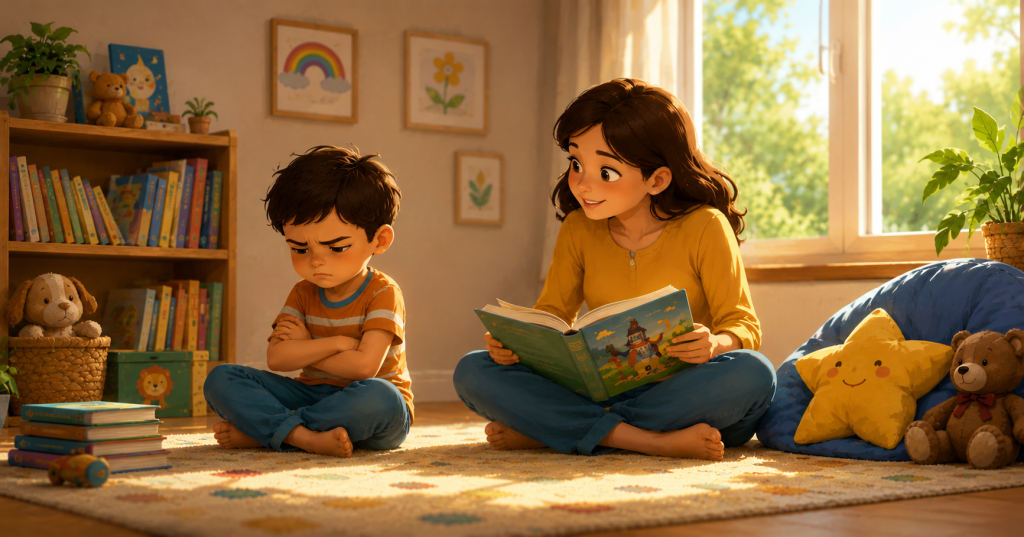
It is 8:30 PM. You have cleared the dinner table, bathed your child, and finally managed to coax them away from the tablet. You pick up a story book — one you carefully chose, one with beautiful pictures and a lovely title. You open to page one.
Your child stares at the ceiling.
You read the first line. They ask for water. You read the second line. They suddenly remember a very important question about dinosaurs. By page three, they are lying sideways with their feet on your shoulder and their eyes pointed at everything except the page.
Sound familiar? You are not failing as a parent. You are just using the wrong approach — and the good news is, the right one is simpler than you think.
Why Building a Reading Habit Early Matters More Than You Think
Research consistently shows that children who read regularly from an early age develop stronger vocabulary, sharper focus, higher emotional intelligence, and better academic outcomes throughout their schooling years. A 2019 study published in Psychological Science found that early reading experiences physically shape the brain’s language processing regions — and those changes last.
But beyond the neuroscience, parents across India are noticing something more immediate: children who read are less hooked on screens, sleep more soundly, and are noticeably calmer and more imaginative. The ripple effects touch every part of their development.
The challenge is not that children don’t like stories. Every child loves stories. The challenge is making books feel as immediate, personal, and exciting as a YouTube video or a Roblox game. And that is entirely possible — with a few smart shifts.
7 Strategies That Actually Build a Reading Habit in Kids
1. Make Your Child the Main Character
The single biggest predictor of whether a child will pick up a book again is whether they felt something the first time. Generic stories about generic characters simply do not land the same way as a story where the hero has your child’s name, loves the things your child loves, and faces adventures that feel made for them.
When a 5-year-old named Aarav opens a book and sees that Aarav is the astronaut who saves the universe, he does not put that book down. He asks for it again. And again. That is how reading habits begin — not with discipline, but with delight. Personalised storybooks that place your child at the centre of the adventure are one of the most powerful first steps any parent can take.
2. Read Together, Not At Them
Many parents read to children in a way that feels like a presentation — they sit beside the child, read the words, and turn pages on cue. Instead, make it a conversation. Pause and ask: ‘What do you think will happen next?’ or ‘What would you do if you were Priya right now?’ or simply ‘Oh no — what is she going to do?’
These micro-interactions transform reading from a passive experience into a participatory one. Participation creates engagement, and engagement builds habit. Even a simple dramatic gasp at the right moment can make a child lean in and forget they were planning to escape.
3. Create a Reading Ritual, Not a Reading Rule
Rules feel like restrictions. Rituals feel like belonging. A bedtime reading routine that is consistent, cozy, and completely free of pressure — same time, same spot, same lamp on low — becomes something children begin to look forward to. Keep the session short to start. Fifteen minutes is enough.
The goal in the first month is not comprehension or reading levels. It is simple association: books equal warmth, closeness, and calm. Once that association is formed, children will come to you with the book. Most parents see this shift within two to three weeks of consistent, no-pressure sessions.
4. Let Them Pick — Even the ‘Wrong’ Book
When children choose their own books — even ones you think are too simple, too silly, or far below their reading level — they build ownership over reading. Ownership creates motivation. If your child wants to read the same picture book for the fifteenth time this week, let them. Repetition in early reading is actually how vocabulary deepens and comprehension strengthens.
The only exception: if a book is causing visible anxiety or distress. Otherwise, follow their lead entirely. The goal right now is for them to associate reading with choice and pleasure — not with being corrected or redirected.
5. Read In Front of Them — Not Just With Them
Children imitate what they observe, not what they are told to do. If you are seen reading — a novel, a newspaper, a magazine, even an article on your phone that you then talk about at the dinner table — your child registers reading as a natural adult activity, not a childhood chore.
Even 10 minutes of visible reading per day, done consistently, sends a powerful signal. You do not need to make a performance of it. Simply read in a shared space, occasionally mention something interesting you came across, and let your child draw their own conclusions.
6. Visit a Bookshop or Library Like It Is Disneyland
The physical ritual of selecting a book matters enormously for young children. Make a monthly trip to a bookshop or public library a special outing — not an errand. Let your child linger, explore, judge books by their covers, pick up five and put down four, and carry their final choice to the counter themselves.
The ownership and pride that comes from choosing their own book translates directly into engagement at home. Children who pick their books almost always read them. Children who are handed books to read often do not.
7. Connect Reading to Their Existing Passions
Is your child obsessed with dinosaurs? Superheroes? Football? Dance? Minecraft? Space? There are excellent books on every single one of these topics — fiction, non-fiction, and everything in between. The fastest way to build a reading habit is to make the first ten books so irresistibly relevant to what your child already loves that they forget they are ‘reading’ and start feeling like they are just getting more information about their favourite thing.
Once they have the experience of being riveted by a book — truly unable to put it down — the habit is essentially formed. All you need to do after that is keep the supply of relevant books coming.
Create a Story They'll Remember Forever
Give your child a personalized storybook that inspires creativity, confidence, and a lifelong love of reading.
Create My Child’s StoryA Simple Bedtime Reading Routine That Actually Sticks
Many parents try to build a reading habit at random times of day — after school, on weekends, whenever there is a quiet moment. These attempts are well-intentioned but rarely work, because without a fixed anchor in the day, the habit never quite sets.
Here is a routine that parents across India have found sustainable, even on busy school nights:
- 8:00 PM — Screens off. No negotiation, no exceptions. Consistent timing trains the brain to expect the transition.
- 8:10 PM — Get comfortable. Dim the lights, get into bed or a favourite reading chair. The physical environment matters more than most parents realise.
- 8:15 PM — Your child picks the book from a pre-selected shelf of age-appropriate options.
- 8:15–8:30 PM — Read together. You read aloud or they read to you. Pause for reactions. Never for comprehension tests.
- 8:30 PM — Lights out. No screen replacement. The story is the last input before sleep.
Within two to three weeks of this routine, most children begin asking for their book before you suggest it. Some will try to negotiate for one more chapter. That is the shift you are working towards — from compliance to craving. And once craving takes over, the hard work is done.
Can Books Really Compete With Screens? (The Honest Answer)
This is the question every modern Indian parent is asking — and the honest answer is: yes, but only if you choose the right books. Screens offer novelty, personalisation, colour, sound, and immediate responsiveness. A generic school reader or a dry chapter book simply cannot compete with that. But a book that is genuinely surprising, laugh-out-loud funny, visually captivating, or deeply personal to your child? That absolutely can.
The secret is not to fight screens with rules. It is to replace screen time with something that offers the same emotional rewards — novelty, engagement, and a feeling of being seen. This is why personalised storybooks, where your child is the main character in their own adventure, are so particularly effective. They offer the same thing a favourite YouTube video offers: a child who is the subject of the story, not just a bystander to it.
Start small. Replace just 15 minutes of screen time with reading — not as a punishment, but as a pleasant alternative. Most parents find that within a few weeks, their child is choosing the book without being asked.
Reading by Age: What Works at Each Stage
Ages 3–5: Sound, Rhythm, and Delight
Children at this age are not reading — they are listening, absorbing, and falling in love with the sound of language. Focus on books with rhyme, rhythm, and repetition. Board books, picture books, and lift-the-flap books are ideal. The goal is one thing only: a deep, warm emotional association with books and reading. Nothing else matters at this stage.
Let them ‘pretend-read’ back to you by looking at pictures. Celebrate this enthusiastically. The confidence and joy they develop now will carry them through the learning-to-read phase without resistance.
Ages 6–8: Identity, Story, and Seeing Themselves
Children in early primary school are beginning to form a sense of who they are. Books where characters share their background, their cultural context, or their personality traits are extraordinarily powerful at this stage. This is the age group for which personalised books — where they are literally the main character — have the greatest impact on reading motivation.
This is also when chapter books become accessible. Introduce short chapter books with lots of illustrations first. The shift from picture books to chapter books is one of the trickiest transitions in a child’s reading journey — make it gradual and low-pressure.
Ages 9–10: Series, Depth, and Independent Reading
Older children who haven’t yet found their ‘book’ almost always unlock reading through a series. When a child falls in love with a character and realises there are five more books waiting, reading becomes compulsive. Introduce one or two age-appropriate series and let curiosity do the rest.
At this age, non-fiction also becomes a powerful entry point — particularly for children who are highly interested in specific subjects. A 10-year-old obsessed with cricket or space or coding will often read non-fiction voraciously while struggling with fiction.
Common Mistakes That Kill the Reading Habit Before It Starts
- Turning reading into a test. Asking comprehension questions after every session makes reading feel like homework. Save those for school; at home, reading should always feel like pleasure.
- Choosing books above their level ‘to challenge them.’ Struggling with every word is demoralising. Let them read slightly below their level at home for confidence and slightly above at school for growth.
- Stopping when they don’t ‘want to’ on day two. The first few days of any new habit involve resistance. Stay gentle, consistent, and short. Don’t give up in week one.
- Rewarding with screen time. This teaches children that reading is a punishment to be escaped, not a pleasure in itself. Reward with a new book instead — it reinforces the habit it’s meant to build.
- Reading only at night. A bedtime story is wonderful, but adding even a five-minute reading moment at another time of day — after school, after lunch — doubles the habit-forming signal.
The Bottom Line
Building a reading habit in your child is not about discipline, rules, or the right reading level. It is about making books feel irresistible — personal, exciting, and emotionally rewarding. Start with one small shift this week: let your child pick the book. Next week, turn off screens fifteen minutes earlier and sit together. The week after that, try a book where they are the main character.
Most Indian parents who make these small, consistent changes report a visible shift in their child’s attitude towards reading within four to six weeks. The hardest part is starting. The best part — once you do — is watching your child ask for one more page.
And that moment, when your child reaches for a book instead of a screen? That is one of the quiet victories of parenting that no reward chart can produce.
Create a Story They'll Remember Forever
Give your child a personalized storybook that inspires creativity, confidence, and a lifelong love of reading.
Create My Child’s Story