The Hidden Power of Storytelling: How Bedtime Stories Shape Your Child’s Brain
Science-backed benefits of reading aloud and telling stories to children — plus how to make it a daily habit
📌 Key Takeaways
What you’ll learn from this article:
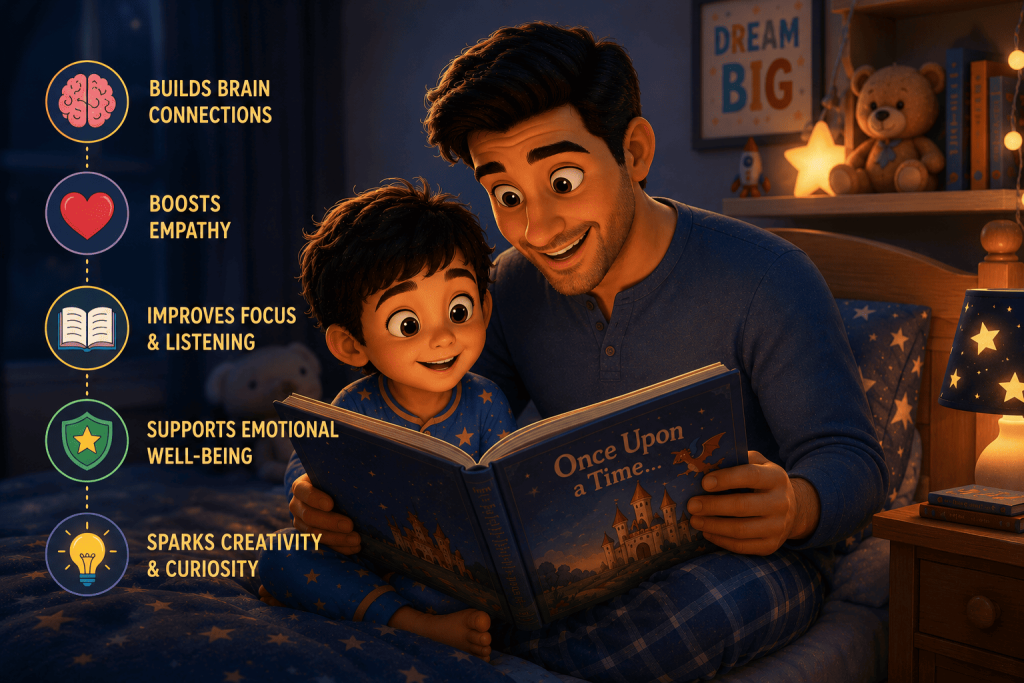
- Bedtime stories are not just a sleep routine — they are one of the most research-supported tools for building vocabulary, empathy, imagination, and a love of reading.
- Reading aloud to a child for 15 minutes a night exposes them to thousands more words per year than children who are not read to — and those words compound over time.
- Stories are how children learn to understand other people’s feelings. Hearing a character’s inner world builds empathy more directly than any explicit lesson can.
- The conversation around a story matters as much as the story itself. Asking ‘what do you think?’ and ‘why did they do that?’ is where much of the learning happens.
- A consistent bedtime story routine does not need perfect books or perfect reading. Consistency and warmth are what make it work.
- Children who are read to regularly are significantly more likely to choose to read independently — the habit plants a seed that grows for years.
Just a Bedtime Routine — Or Something More?
Most parents who read to their children at night do not think of it as an educational activity. They think of it as a way to wind down, to spend a few quiet minutes together, to signal that the day is ending. And it is all of those things.
But it is also something else. Those fifteen minutes — one book, two books, the same book read for the sixth time this week — are doing something specific and measurable to your child’s brain. Researchers have been studying it for decades, and what they have found is more interesting than most parents realise.
This is not an article designed to add pressure to your evenings. It is the opposite. It is an argument for taking something you are already doing — or thinking about doing — and understanding why it is one of the best uses of fifteen minutes you will find in a day.
What the Research Actually Shows
It builds vocabulary faster than almost anything else
Children learn language in two ways: through conversation, and through books. Conversation is essential — but it has limits. The words we use in everyday speech are a relatively small and repetitive set. Books, especially picture books and stories for young children, contain a far wider range of vocabulary.
Researcher Marilyn Jager Adams estimated that children who are read to regularly hear roughly 1.4 million more words per year than children who are not. Over six years of early childhood, that gap becomes enormous — and it is one of the primary reasons why children who were read to regularly arrive at school with significantly larger vocabularies than those who were not. Vocabulary, in turn, predicts reading comprehension, writing ability, and academic performance across almost every subject.
The key word is exposure. Children do not need to understand every word they hear in a story. They absorb the rhythm, the context, the sound of new words being used naturally. The meaning comes later, sometimes days later, sometimes in a different conversation entirely. The exposure plants the seed.
It builds empathy
This one surprises people. Empathy — the ability to understand and share another person’s feelings — is not usually thought of as something that comes from books. But the evidence is strong.
Psychologist Raymond Mar at York University has spent years studying the relationship between fiction and empathy. His research consistently shows that children who are exposed to narrative fiction — stories with characters, feelings, and inner lives — develop stronger theory of mind. Theory of mind is the ability to understand that other people have thoughts, feelings, and perspectives different from your own. It is the cognitive foundation of empathy.
When a child listens to a story about a character who is frightened, lonely, brave, or confused, they practice stepping into another person’s experience. They do this dozens of times per book, hundreds of times per year. Over childhood, this practice accumulates into a genuine capacity for empathy — not because they were taught to be empathetic, but because they spent years living briefly inside other people’s stories.
It builds brain connections that last
Neuroscientist Dr. John Hutton at Cincinnati Children’s Hospital scanned the brains of children aged 3–5 while they listened to stories. The results were striking: children who were regularly read to at home showed significantly more activity in the parts of the brain responsible for language, mental imagery, and narrative comprehension — not just during the scan, but as a baseline. The habit of story time was literally building brain architecture.
The window for this kind of structural brain development is widest in the early years. The brain is more plastic, more receptive, and more shaped by experience between birth and age 8 than at any other time in life. What a child’s brain is exposed to during these years—the words, the stories, and the rhythms of language—leaves a physical mark. This is why helping your child develop a consistent reading habit from an early age can have such a lasting impact.
Beyond the Science: What Story Time Does for the Relationship
Most of the research on reading aloud focuses on cognitive outcomes. But there is something equally important that the studies do not fully capture: what story time does for the connection between parent and child.
The fifteen minutes before bed, when a child is settled and calm and you are sitting together with a book — that is one of the few moments in a day that belongs entirely to the two of you. No errands, no phone, no other agenda. Just the story and the child beside you.
Children remember this. Not the specific books, necessarily, but the feeling. The warmth, the closeness, the reliable ritual of it. In surveys of adults asked about their childhood memories, stories shared at bedtime come up again and again — not because the books were remarkable, but because the presence was.
This matters for communication too. Children who feel safe and connected with a parent talk more openly, ask more questions, and express themselves more freely at home. Story time is not just brain development — it is relationship maintenance, and relationship is the foundation on which everything else is built.
Stories and the Imagination
When a child reads a book — or has one read to them — they do something a screen cannot replicate. They build the images themselves. A sentence like ‘the forest was dark and full of sounds she didn’t recognise’ creates a different picture in every child’s mind, drawn from their own experience, their own fears, their own sense of what darkness sounds like.
This act of visual construction — of turning words into pictures — is the foundation of imagination. And imagination is not just a pleasant quality. It is the mechanism behind creativity, problem-solving, empathy, and abstract thinking. Children who have strong imaginations are better at considering different perspectives, generating solutions to problems, and thinking about things that are not immediately in front of them.
A steady diet of story — heard, read, told — builds this capacity more reliably than almost anything else. It is also one of the things that screen time, for all its merits, does not do. Video delivers the images already made. Books ask the child to make them, which is an entirely different cognitive exercise.
Create a Story They'll Remember Forever
Give your child a personalized storybook that inspires creativity, confidence, and a lifelong love of reading.
Create My Child’s StoryHow to Build a Bedtime Story Routine That Sticks
The research is clear, but research does not put books on shelves or carve fifteen minutes out of a busy evening. Here is what actually works.
Start with consistency, not perfection
The single thing that makes a bedtime routine stick is consistency — same time, same place, same general shape each night. It does not matter if you are tired, if the book is not very good, or if you read slightly flatly that evening. Children are not grading the performance. They are imprinting the ritual.
Aim for five nights out of seven rather than every single night. That is sustainable. Five good nights consistently for a year will do more than seven perfect nights followed by two weeks of missed evenings.
Let your child choose the book
The fastest way to kill a reading routine is to turn it into an assignment. The book your child picks — even if it is the same one every night for a fortnight, even if it is well below their reading level, even if you have read it so many times you could recite it — is the right book. Ownership creates motivation. Repetition, in early childhood, is not boredom. It is mastery.
Make it a conversation, not a performance
The habit of talking about books as you read them is where much of the learning happens. You do not need to quiz your child or test comprehension. Just wonder out loud: ‘I’m not sure why she did that, are you?’ or ‘I wonder what’s going to happen next’ or ‘That happened to me once.’ These small moments of reflection — brief, warm, undemanding — are the conversations that build language, empathy, and critical thinking alongside the story.
Tell stories without books too
Made-up stories — invented on the spot, improvised, ridiculous — have all the same benefits as book stories plus one extra: the child watches someone they love create something from nothing. This is enormously normalising. It shows that storytelling is not something that only happens in books. It is something humans do, naturally, all the time. And it invites the child to join in. ‘What should happen next?’ is one of the most powerful questions you can ask a 4-year-old.
Small Things That Make a Big Difference
| Quick Tips for Story Time Read with expression. You do not need to be an actor. Just change your voice slightly for different characters, slow down at tense moments, speed up during excitement. Children respond to this and remember more of what they heard. Point to words as you read. For children who are beginning to read, running your finger under the words as you say them builds the connection between spoken and written language. Even briefly. Revisit favourite books. Repetition is not a failure of imagination. A child asking to hear the same story again is processing it more deeply each time. The third reading is different from the first. Put the phone away. Not on silent. Away. Children notice where your attention is directed. Fifteen minutes of genuine presence is worth more than an hour of half-attention. End with a question. Even one: ‘What was your favourite part?’ The child goes to sleep with the story still in their head, thinking. This consolidates memory more than simply closing the book. |
For Busy and Working Parents
Many Indian parents — especially those with long commutes or late work hours — feel guilt about not being present for bedtime consistently. A few things worth knowing:
- Fifteen minutes is genuinely enough. You do not need an hour. The research on vocabulary and brain development is based on daily reading of around 15 minutes. The habit does not have to be long to be powerful.
- An audiobook or a grandparent reading aloud is not a second-best substitute. The benefits of story time come from the child’s brain engaging with narrative — whether that is your voice, an elder’s voice, or a well-made audio recording.
- Weekend story sessions can partially compensate for weekday gaps. Three or four good story sessions a week still builds the habit and delivers most of the benefit.
- Children who know a story is coming at the end of the day carry that anticipation through it. Even the promise of a story — ‘tonight we’ll find out what happens next’ — creates the mental engagement that makes reading powerful.
The Simple Version
Everything in this article comes down to one thing: read to your child. Regularly, warmly, without pressure, with whatever book they choose.
You do not need to optimise it. You do not need to find the best books or follow a curriculum or make sure every session is educationally rich. You just need to show up with a book, sit close, and read.
The brain development will happen on its own. The vocabulary will grow quietly. The empathy will develop in the background. The love of reading will root itself somewhere in those evenings and stay there for decades. All you have to do is begin.
Create a Story They'll Remember Forever
Give your child a personalized storybook that inspires creativity, confidence, and a lifelong love of reading.
Create My Child’s Story