Child Development Milestones by Age: What to Expect from 1 to 10 Years in India
A parent's clear guide to physical, cognitive, emotional, and language milestones — and when to seek support
📌 Key Takeaways
What you’ll learn from this article:
- Child development unfolds across four areas — physical, language, cognitive, and emotional — and all four matter equally.
- Milestones are averages, not deadlines. A child who reaches a milestone a few months later than the chart suggests is often completely typical.
- Development in India looks slightly different from Western norms — multilingual homes, joint families, and different play environments all shape how and when skills emerge.
- Early identification of developmental gaps makes a significant difference. Knowing what to look for — and when to seek support — is every parent’s most useful tool.
- The single most powerful thing parents can do at every stage is talk with their child, read with them, and give them safe space to explore.
- No child develops in a straight line. Regressions, pauses, and leaps forward are all part of normal development.
The Chart on the Doctor’s Wall
Most parents have sat in a paediatrician’s waiting room at some point, staring at a developmental milestones chart on the wall and doing quiet arithmetic. Is my child where they should be? Are they ahead? Behind? What does ‘behind’ even mean?
These charts are useful, but they are also frequently misread. They describe what the average child can do at a given age — not what every healthy child must do. Development does not run on a fixed schedule, and the variation in what is considered typical is far wider than most parents realise.
This guide is for parents who want to understand what to expect across the full span of early childhood — the major milestones in physical development, language, cognitive ability, and emotional growth, from age 1 through to 10. It is also, where relevant, about understanding how development looks in Indian homes specifically, because our environment shapes development in ways that generic Western charts do not always capture.
How to Read This Guide
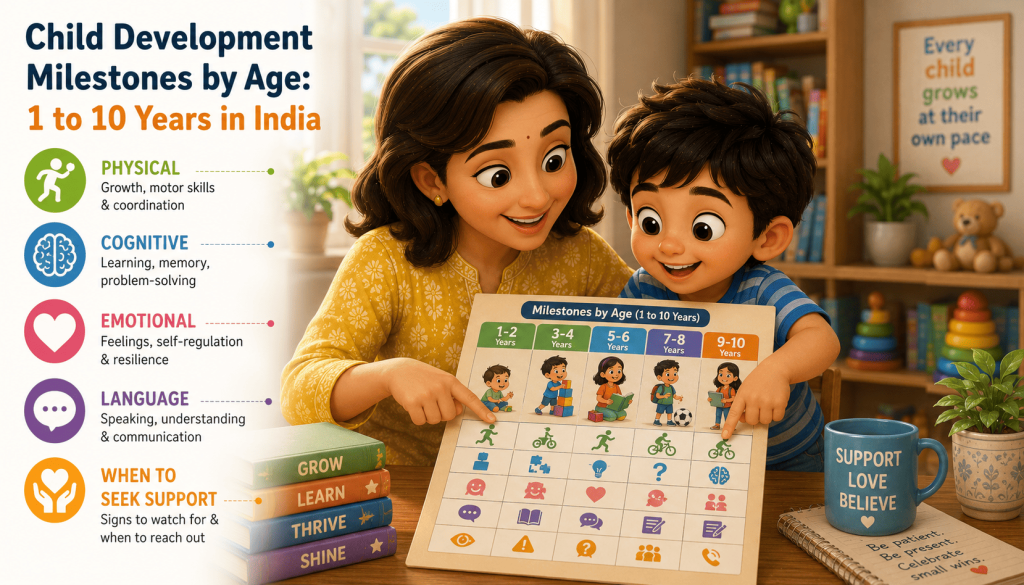
Each age section covers four areas: physical development, language, cognitive skills, and emotional and social development. These are not separate tracks — they influence each other constantly. A child whose language develops quickly often has an easier time with emotional regulation, because they can name what they feel. A child who is physically confident tends to try new things more readily, which builds cognitive flexibility.
A few things to hold in mind as you read:
- Milestones are ranges, not deadlines. The age given is typically when most children reach a milestone — but ‘most’ means roughly 75–80%. A significant number of typically developing children reach the same milestone weeks or months later.
- Girls and boys often follow slightly different timelines, particularly in language development, where girls on average develop a little earlier.
- Multilingual homes — which is the norm in India — are associated with slightly different language timelines. A child learning two or three languages simultaneously may mix them, translate between them, and appear to have a smaller vocabulary in each individual language. This is normal, not a delay.
- Joint family environments, which remain common across India, affect social development. Children in joint families tend to develop social skills around group dynamics, turn-taking, and reading adult relationships earlier than children in nuclear families.
- If your child has missed multiple milestones in one area, or if you have a persistent feeling that something is not right, follow that instinct and speak to a professional. Parents are often the first to notice.
Milestones by Age
| Ages 1–2: The Explorer Physical Pulls to stand, then takes first steps, usually by 12–15 months Walks independently and begins to climb stairs with support by 18 months Starts to feed themselves with a spoon, with significant mess Can stack 2–4 blocks by age 2 Language First words appear between 10–14 months — ‘amma’, ‘papa’, ‘nahi’ Vocabulary reaches roughly 50 words by age 2, though range varies widely Begins combining two words: ‘more milk’, ‘dada go’, ‘no nap’ In multilingual homes, words from all languages count toward vocabulary total Cognitive Object permanence is well established — they know things exist even when hidden Points to show you things that interest them (a big social-cognitive step) Begins simple pretend play: ‘feeding’ a doll, ‘talking’ on a toy phone Understands simple instructions: ‘give it to me’, ‘come here’ Emotional & Social Strong attachment to primary caregivers; separation anxiety is normal and healthy Begins showing a range of emotions clearly: joy, frustration, fear, affection Parallel play — plays near other children but not yet with them Starts asserting preferences and the word ‘no’ becomes very popular |
| Ages 3–4: The Conversationalist Physical Runs, jumps, and climbs with increasing confidence Can pedal a tricycle; kicks and throws a ball with some accuracy Begins drawing recognisable shapes — circles, crosses, basic faces Dresses and undresses with some help; can manage large buttons Language Speaks in sentences of 4–6 words; strangers can understand most of what they say Asks ‘why’, ‘what’, ‘who’, ‘when’ — frequently and persistently. Learn why kids ask so many questions Tells simple stories about their day; beginning to understand past and future tense Knows their own name, age, and usually their city or neighbourhood Cognitive Sorts objects by colour, shape, and size Understands the concept of ‘same’ and ‘different’ Begins to count, usually up to 10 by age 4, though rote and genuine understanding differ Engages in extended pretend play with storylines and assigned roles Emotional & Social Plays with other children and begins navigating simple social rules (sharing, turn-taking) Tests boundaries consistently — this is healthy autonomy development, not defiance Begins to show empathy: notices when someone is sad and may try to comfort them Strong imagination; the line between real and pretend is blurry and that is normal |
| Ages 5–6: The Learner Physical Skips, hops on one foot, rides a bicycle with training wheels Hand preference (left or right) is usually established Fine motor skills improve significantly: can write letters, cut with scissors Can dress independently, tie shoelaces with practice Language Speaks clearly in complex sentences; grammar is mostly correct Vocabulary of 2,000–2,500 words in their primary language by age 6 Can retell a story with beginning, middle, and end Strong storytelling often goes hand in hand with confident communication. Discover simple ways to improve your child’s communication skills at home. Begins to read simple words; connects spoken sounds to written letters Cognitive Understands that things can be grouped in multiple ways (a mango is both a fruit and yellow) Beginning to understand that others have different thoughts and knowledge (theory of mind) Can follow multi-step instructions: ‘wash your hands, dry them, and come to the table’ Attention span increases to roughly 15–20 minutes for a chosen activity Emotional & Social Friendships become important; best friends appear Increasingly aware of social rules and fairness — ‘that’s not fair’ becomes a refrain Competitive feelings emerge; handling losing is a skill actively being developed Can name and talk about emotions with some accuracy when calm |
Create a Story They'll Remember Forever
Give your child a personalized storybook that inspires creativity, confidence, and a lifelong love of reading.
Create My Child’s Story| Ages 7–8: The Thinker Physical Physical coordination is much closer to adult levels; sports become genuinely enjoyable Handwriting is more controlled; can write full sentences and short paragraphs Permanent teeth are coming in; growth is steady but less dramatic than earlier years Can perform sequences of movement: swimming strokes, dance steps, martial arts forms Language Reads independently; reading for pleasure becomes possible Can write short stories, letters, and accounts of events Vocabulary continues growing rapidly — exposure to books accelerates this significantly Sarcasm, jokes with wordplay, and puns start making sense (and becoming tiresome) Cognitive Can think logically about concrete situations — understands cause and effect more fully Understands that quantities do not change when their appearance changes (conservation) Can plan ahead, set simple goals, and evaluate whether they achieved them Growing ability to see someone else’s point of view Emotional & Social Peer relationships are central; being accepted by the group matters a great deal More self-aware — comparisons to peers increase, as does self-criticism Beginning to develop a stable sense of identity: what they are good at, what they like Can manage emotions better in public; learns to ‘hold it together’ until a safe moment |
| Ages 9–10: The Independent Physical Physical skills are well-developed; children this age can learn complex sports and activities Early signs of puberty may begin, particularly in girls Fine motor skills are close to adult level; handwriting is usually consistent Increased stamina; can sustain physical activity for extended periods Language Reads chapter books independently; can navigate non-fiction for information Writes with structure — paragraphs, main ideas, supporting details Vocabulary is rich enough to express complex ideas and abstract concepts Can hold a sustained, two-way conversation about complex topics with adults Cognitive Begins to think abstractly — can consider hypothetical scenarios and what-if questions Can organize information, compare and contrast, and draw conclusions Study habits are forming; can work independently for 30–45 minutes on a task Growing metacognition — awareness of how they learn, what they find difficult Emotional & Social Peer relationships are the primary social world; family influence is still strong but competes more Beginning to question rules and authority — not disrespectfully, but genuinely More private about feelings, particularly with parents Moral reasoning develops: a strong sense of right and wrong, justice, fairness As children grow, helping them recognise, understand, and manage these emotions becomes just as important as academic learning. Learn practical ways to build emotional intelligence in children. |
What Helps at Every Stage
Across all ages from 1 to 10, the research on child development points to the same handful of things that make the biggest difference:
- Talk with them, not just at them. Conversation — real back-and-forth — is the single most effective language and cognitive development tool available, at every age.
- Read together. The vocabulary, empathy, and brain development benefits of regular reading are well-established and begin in infancy. They do not stop at age 5.
- Give them safe space to try and fail. Confidence, problem-solving, and resilience all develop through managed challenge — not through being protected from difficulty.
- Follow their interests. A child who is fascinated by insects, trains, or cooking will learn faster in every domain when you connect learning to what they already love.
- Be present. Not necessarily for more hours — but genuinely present during the time you have. Children develop best in the presence of attentive, warm adults.
When to Seek Professional Support
Milestones exist to guide, not to alarm. Most children who are slightly behind in one area catch up naturally. But there are situations where early professional input makes a significant, lasting difference:
- No words at all by 16 months, or no two-word combinations by 24 months.
- Loss of skills the child previously had — words, social behaviours, or physical abilities that have disappeared.
- Significant difficulty in one area across several consecutive milestones — for example, consistently delayed language across ages 2, 3, and 4.
- A strong parental instinct that something is not right. Parents who know their child well are often the first to notice something worth exploring.
- Behaviour that causes significant distress to the child across all settings — home, school, and social — for more than a few weeks.
In India, paediatricians, child psychologists, and speech-language therapists are the right starting points. In most cities, these services are now available in-person and online. Early input is almost always more effective than waiting to see if a child ‘grows out of it.’
The Bigger Picture
Child development is not a race or a ranking. It is a journey that looks slightly different for every child, shaped by their biology, their environment, their family, and their own particular way of moving through the world.
The milestones in this guide are signposts, not scorecards. They tell you roughly where the road goes — not how fast your child must travel it.
What matters more than any chart is this: a child who feels safe, loved, and genuinely known by the people around them will develop. Not always on schedule, not always without detours, but steadily and in their own direction. Your attention to who they are — not just what they can do — is the most developmentally significant thing you can offer.
Create a Story They'll Remember Forever
Give your child a personalized storybook that inspires creativity, confidence, and a lifelong love of reading.
Create My Child’s Story