Raising an Emotionally Intelligent Child: What EQ Means and Why It Matters More Than IQ
Age-appropriate activities that teach children to name, understand, and manage their emotions
📌 Key Takeaways
What you’ll learn from this article:
- Emotional intelligence (EQ) is the ability to recognise, understand, and manage emotions — in yourself and in others. It is learnable at any age, but the early years are the best time to build it.
- Research consistently shows that EQ predicts life outcomes — career success, relationship quality, mental health — more reliably than IQ alone.
- Children are not born knowing how to handle big emotions. They learn it, primarily by watching the adults around them and being guided through their own emotional experiences.
- The four building blocks of EQ — emotional awareness, emotional vocabulary, empathy, and self-regulation — can each be developed through simple, everyday habits at home.
- Validating a child’s emotion is not the same as agreeing with their behaviour. You can say ‘I understand you’re angry’ and still hold a firm boundary.
- Children who develop strong EQ handle setbacks better, make friends more easily, perform better academically, and are significantly less likely to experience anxiety and depression.
The Child Who Cannot Calm Down
It is 7 PM. Your child lost a board game fifteen minutes ago. The game is long over. Everyone has moved on. But your child has not. They are still on the floor, still crying, still furious — and now angry that the crying will not stop.
Or maybe it is the opposite: your child never seems to show much. When something goes wrong, they go quiet. When you ask how they feel, they shrug. When they are clearly upset, they insist they are fine.
Both of these are children who have not yet developed the tools to handle what is happening inside them. Not because they are difficult, or dramatic, or cold — but because emotional regulation is a skill, not a personality trait. And like all skills, it has to be learned.
This is what emotional intelligence is: the ability to notice, name, understand, and work with emotions — your own and other people’s. It is teachable, it is measurable, and the research on why it matters is more compelling than most parents realise.
Why EQ Matters More Than Most Parents Think
In 1995, psychologist Daniel Goleman published research arguing that emotional intelligence predicted life success more reliably than IQ. The claim was bold and initially controversial. But in the three decades since, the evidence has only grown stronger.
A landmark study that followed children from early childhood into adulthood found that the ability to delay gratification at age 4 — a core EQ skill — predicted higher SAT scores, better social functioning, and lower rates of substance abuse decades later. Not slightly. Significantly.
More recent research from Penn State and Duke Universities, tracking over 700 children from kindergarten to adulthood, found that social and emotional skills at age 5 were among the strongest predictors of whether children would graduate university, hold stable employment, and avoid criminal records. Stronger than IQ. Stronger than family income.
This does not mean IQ does not matter — it does. But IQ without EQ tends to produce people who are capable and difficult to work with. EQ without high IQ tends to produce people who are warm, resilient, and genuinely effective in the world. And children who develop both do best of all.
In the Indian context, where academic pressure begins early and the emphasis on intelligence and marks is intense, EQ is the quality that is most consistently underdeveloped — and most consistently undervalued, until adulthood makes its absence visible.
The Four Building Blocks of Emotional Intelligence
EQ is not one single skill. It is built from four interlocking capacities, each of which can be developed deliberately at home.
1. Emotional Awareness — Noticing What You Feel
Before a child can manage an emotion, they have to notice it. This sounds obvious, but many children — and adults — go through daily life only dimly aware of their own emotional state. They know they are ‘fine’ or ‘not fine.’ The spectrum in between is a blur.
Emotional awareness means being able to notice the specific texture of what you are feeling: this is frustration, not anger. This is nervousness, not sadness. This is disappointment, which is different from shame. The more precisely a child can identify their emotional state, the more choices they have about how to respond to it.
2. Emotional Vocabulary — Putting Words to Feelings
Vocabulary for emotions works the same way as vocabulary for anything else: the more words a child has, the more precisely they can think and communicate. A child with a limited emotional vocabulary can only say they feel ‘bad’ or ‘angry.’ A child with a rich one can say they feel left out, or embarrassed, or overwhelmed, or let down.
This precision matters practically. ‘I feel left out’ is information a parent or teacher can work with. ‘I feel bad’ is not. And internally, being able to name an emotion with precision reduces its intensity — a finding replicated in neuroscience research that shows labelling an emotion decreases activation in the amygdala, the brain’s threat-response centre.
3. Empathy — Understanding What Others Feel
Empathy is the ability to step into another person’s emotional experience — not to fix it or judge it, but to understand it. It is the foundation of every meaningful relationship, and it develops through being around people who model it and through being on the receiving end of it.
Children learn empathy primarily by experiencing it. A child who grows up having their own emotions consistently acknowledged and taken seriously develops the neural pathways and the habit of doing the same for others. A child whose emotions are dismissed, minimised, or punished learns, over time, to dismiss the emotions of others.
Empathy and curiosity often grow together. Children who ask questions about people, situations, and feelings are actively learning how others experience the world. If your child constantly asks “why,” that’s usually a good sign. Learn more in Why Does My Child Ask So Many Questions?
4. Self-Regulation — Managing What You Feel
Self-regulation is the capacity to manage emotional responses — to feel something strongly and still choose how to behave. It is the last of the four capacities to develop, and the one that requires the most practice over the longest period of time.
The prefrontal cortex — the brain region responsible for self-regulation — is not fully mature until the mid-twenties. This means a 6-year-old who melts down over a lost game is not failing at self-regulation. They are operating with an incompletely developed regulatory system. The job of the adult is not to demand regulation before the capacity exists, but to support its development with patience, modelling, and gradually increasing expectation.
Create a Story They'll Remember Forever
Give your child a personalized storybook that inspires creativity, confidence, and a lifelong love of reading.
Create My Child’s StoryBuilding EQ at Home: Activities by Age
None of the following require special materials or dedicated sessions. They are all built into conversations and moments that already exist in a normal day.
Ages 3–5: Name It to Tame It
The priority at this age is emotional vocabulary. Children this age are experiencing a full range of emotions but lack the words to identify them. Your main job is to name emotions as they arise — yours and theirs — out loud and without drama.
- When your child is upset: ‘You look really disappointed that we can’t go to the park today. That makes sense.’
- When you stub your toe: ‘Ouch — I’m feeling frustrated right now. I need a moment.’
- When reading a picture book: ‘Look at her face — what do you think she’s feeling? She looks a bit worried, doesn’t she?’
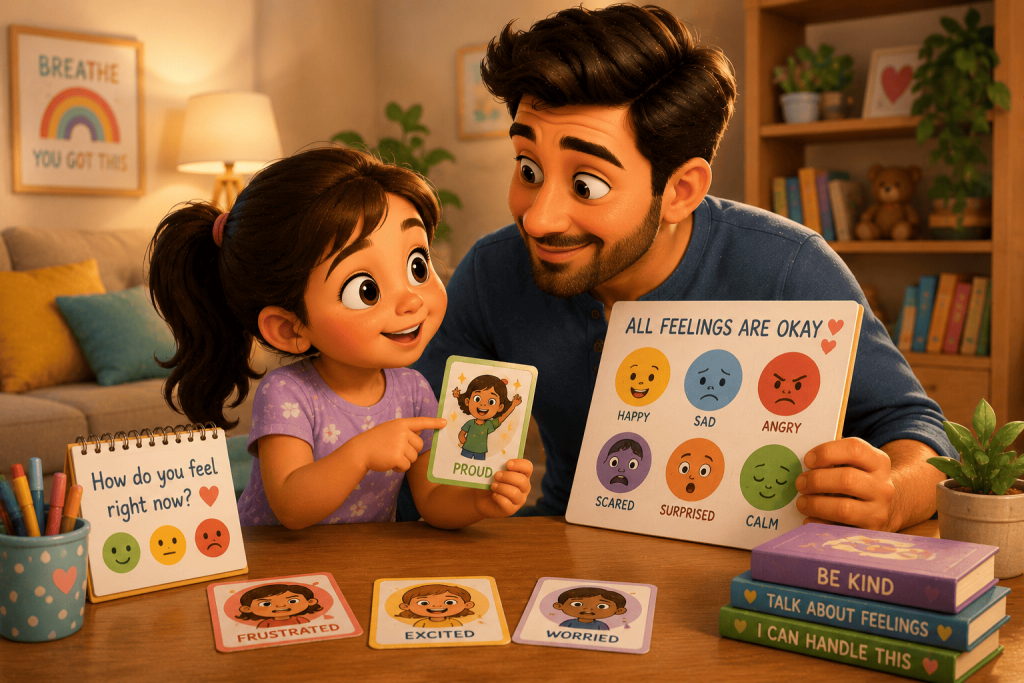
- Use a ‘feelings chart’ — a simple poster with cartoon faces showing different emotions — on the fridge or bedroom wall. At calm moments, point to faces and talk about when you feel each one.
The goal is not perfect identification. It is familiarity. A 4-year-old who has heard ‘that sounds frustrating’ a hundred times will eventually begin to say it themselves.
Ages 6–8: The Feelings Conversation
Children at this age can begin to have genuine conversations about emotions — what causes them, how they feel in the body, and what helps when they are overwhelming. They are also beginning to notice emotions in others more consistently.
- At dinner, try a simple round: everyone shares one feeling they had today — not an event, a feeling. ‘I felt proud when…’ / ‘I felt nervous about…’ / ‘I felt relieved when…’ This normalises emotional language as a family habit.
- When your child is upset, try the RULER approach: ‘Can you Recognise what you’re feeling? Where do you feel it in your body? What do you think caused it? What do you want to do about it?’
- After a film or a story, ask: ‘Which character do you think had the hardest time? What do you think they were feeling? Have you ever felt something like that?’
- Teach the body-check habit: ‘Before you react, notice where you feel it. Tight chest? Clenched hands? That’s your body telling you something.’
Ages 9–10: Empathy and Perspective-Taking
Older children can begin to work with more complex emotional situations — particularly around peer relationships, fairness, and their own role in conflict. At this age, empathy and perspective-taking become the focus.
- When they describe a conflict with a friend, try asking: ‘What do you think it looked like from their side?’ Not as a gotcha, but out of genuine curiosity.
- Read biographies and stories together about people facing real emotional challenges. Talk about how the character managed — or failed to manage — difficult feelings.
- When they face disappointment or failure, coach the debrief: ‘That was hard. What do you feel right now? What helped last time something felt like this?’
- Model disagreement done well: let your child occasionally see you disagree with a partner or family member calmly, acknowledge the other person’s perspective, and reach a resolution without anyone being crushed.
The Most Important Skill: Validating Without Agreeing
The single most consistent finding in EQ research is that children who feel emotionally understood are more emotionally intelligent. Not children who are always agreed with. Not children who are always given what they want. Children who feel that their emotional experience is recognised as real and valid.
Validation is not agreement. ‘I understand you’re furious that I said no’ is not the same as changing the answer. The boundary can stay exactly where it is. What the child needs is not to win — it is to feel heard.
When an emotion is validated, the brain’s threat response decreases. The child becomes more available to hear what happens next. When an emotion is dismissed — ‘stop crying, there’s nothing to cry about’ — the brain’s threat response intensifies. The child escalates. The situation worsens. And crucially, the child learns that their emotional world is not a safe thing to share.
| Validation in Practice Instead of: “Stop overreacting.” Try: “That really upset you. Tell me what happened.” Instead of: “You’re fine, it’s not a big deal.” Try: “It feels like a big deal to you, and that matters.” Instead of: “Don’t be so sensitive.” Try: “You felt that deeply. I hear you.” Instead of: “There’s no reason to be scared.” Try: “You feel scared, and I’m right here with you.” Instead of: “Stop crying or I’ll give you something to cry about.” Try: “You’re really upset. Let’s sit here until it passes.” |
Emotional Intelligence in the Indian Family Context
Emotional expression in many Indian households has traditionally followed a particular pattern: adults do not discuss their feelings openly with children, difficult emotions are managed privately, and children are expected to regulate their emotions through self-control rather than self-understanding.
This is not a failure of parenting. It is a cultural approach that has its own logic — prioritising composure and social harmony, teaching children to manage appearance and behaviour. But it has a consistent side effect: children who do not know what they feel, or who feel it intensely but cannot name or manage it, and who eventually express it in ways that are harder to address.
Building EQ in an Indian family context does not require dismantling cultural values. It means adding a layer. You can still expect your child to behave appropriately in public and to show respect to elders — and also give them the vocabulary and the safe space, at home, to say that something was hard, that they were scared, that they felt left out. The two are not in conflict.
In fact, the most emotionally intelligent children are often those who can code-switch: composed and respectful in formal settings, open and emotionally articulate in safe ones. That is not emotional repression. That is emotional sophistication.
What Emotionally Intelligent Children Look Like
They are not the children who never get angry, never cry, and never struggle. They are the children who, when they are angry, can eventually say why. When they are scared, can tell someone. When they hurt a friend, can apologize with genuine understanding of what they did.
They are the children who, at 25, can hold a difficult conversation without shutting down. Who can lose something they wanted badly and recover without being crushed. Who can sit with another person’s pain without immediately trying to fix it or escape it.
That child is built slowly, at home, in ordinary moments — over years of being heard, guided, and gently helped to make sense of the complicated, powerful, utterly human experience of having feelings.
Create a Story They'll Remember Forever
Give your child a personalized storybook that inspires creativity, confidence, and a lifelong love of reading.
Create My Child’s Story