Getting Kids Ready for School Without Yelling: A Fun Challenge That Worked for Us
Tired of school morning battles? Try this fun 21-day puzzle challenge that helped our child get ready for school without constant reminders.
📌 Key Takeaways
What you’ll learn from this article:
- School mornings can become stressful for both parents and children, especially when everyone is rushing against the clock.
- Children often respond better to play, challenges, and positive reinforcement than repeated reminders or yelling.
- Turning getting ready into a 21-day puzzle challenge can help build consistency and make mornings more enjoyable.
- Research suggests that repeated practice over several weeks can help establish new routines and habits.
- A calmer morning routine can improve your child’s mood, reduce conflicts at home, and help them start the school day feeling more confident and prepared.
Morning Challenge
“Mumma… just five more minutes.”
If you’re a parent of a school-going child, chances are you’ve heard this almost every morning.
The alarm rings.
You wake up early.
Pack the tiffin.
Fill the water bottle.
Iron the uniform.
Check the homework diary.
And then comes the hardest part of the morning…
Getting your child out of bed and ready for school on time.
“Brush your teeth.”
“Wear your shoes.”
“Drink your milk.”
“Where is your ID card?”
“We’ll miss the school bus!”
What begins as gentle reminders can quickly turn into frustration, raised voices, and a stressful start to the day.
The truth is, many Indian parents silently struggle with school mornings.
And children struggle too.
They’re transitioning from sleep to structure. They’re being asked to stop doing what they enjoy and start doing things they have to do.
As parents, we often try to solve this with more reminders.
But children don’t always respond to pressure.
They respond to play.
The Morning Challenge That Changed Everything
One day, instead of turning mornings into a checklist, we turned them into a game.
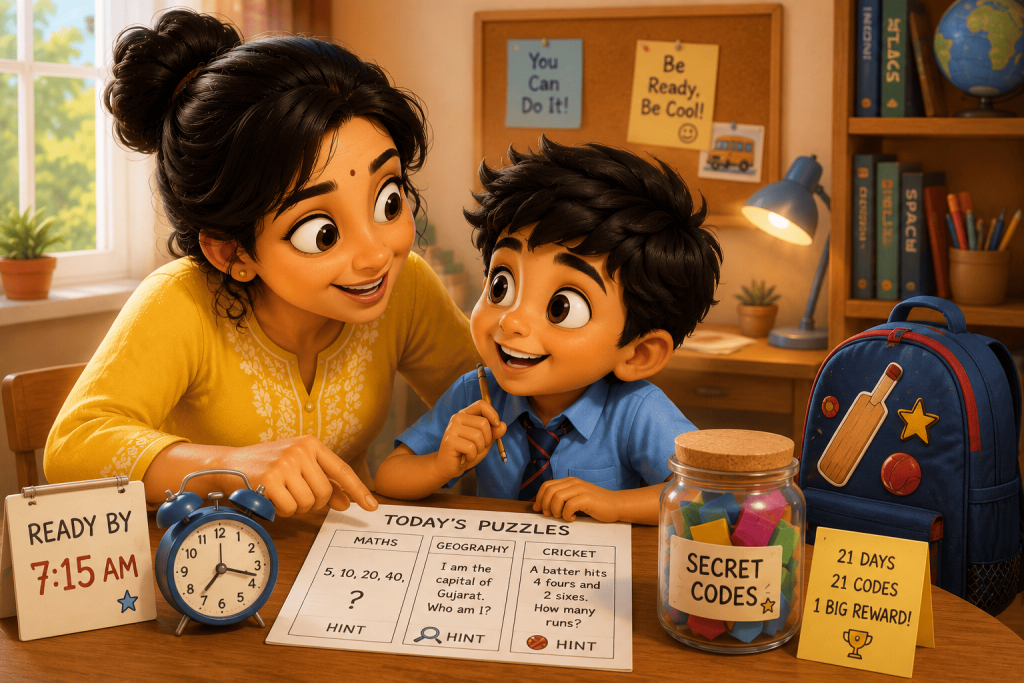
We introduced a 21-Day Morning Puzzle Challenge.
The rule was simple.
If our child was completely ready 15 minutes before leaving for school, they unlocked the day’s secret puzzles.
For example:
- Going to school at 7:30 AM.
- Child must be ready by 7:15 AM.
- Uniform on ✓
- Teeth brushed ✓
- Breakfast finished ✓
- School bag packed ✓
Only then…
The Puzzle Challenge could begin.
And suddenly, something changed.
The constant reminders reduced.
The rushing reduced.
Because the motivation shifted from:
“Mumma wants me to get ready.”
to
“I don’t want to miss today’s challenge!”
Why This Works
Children naturally enjoy:
- Games
- Challenges
- Predictability
- Small achievements
This challenge uses positive reinforcement rather than criticism.
Instead of focusing on what children are doing wrong, it rewards the behaviour we’d like to see more often.
More importantly, it preserves the parent-child relationship.
You become their teammate instead of the morning police officer.
Create a Story They'll Remember Forever
Give your child a personalized storybook that inspires creativity, confidence, and a lifelong love of reading.
Create My Child’s StoryHow to Create Your Own 21-Day Morning Challenge
Step 1: Decide the Ready Time
Choose a realistic target.
For example:
- Leave home: 7:30 AM
- Puzzle unlock time: 7:15 AM
Explain it with excitement:
“If you’re all set by 7:15, you’ll unlock today’s secret mission!”
Step 2: Choose Topics Your Child Loves
Ask them:
“What kind of puzzles would you love solving every morning?”
Ideas include:
- Cricket
- Maths
- Geography
- Space
- Animals
- Dinosaurs
- Cars
- General Knowledge
The more personalized it feels, the more invested they’ll be.
Step 3: Create Three Puzzles the Night Before
Use ChatGPT, Claude, or Gemini to generate age-appropriate questions.
Try prompts like:
“Create 3 fun cricket puzzles for an 8-year-old Indian child. Make them moderately challenging and provide hints.”
Or:
“Create 3 geography puzzles suitable for a Class 4 student in India. Not too easy and not too difficult.”
Step 4: Give One Secret Code Every Day
After your child solves the three puzzles, they receive one secret code for the day.
The code can be:
- A letter
- A number
- A symbol
Write it down and place it inside a special jar.
If your child struggles, give hints. Solve the puzzle together if needed.
Remember:
The goal is not to conduct an exam.
The goal is to make getting ready for school feel exciting and predictable.
After 21 days, they’ll have collected 21 secret codes.
Those codes unlock the final reward.
Step 5: Celebrate the 21st Day
The reward doesn’t have to be expensive.
Ideas include:
- Visit to trampoline park
- A cricket bat
- A family movie night
- Ice cream together
- A science kit
- A picnic
- A personalized storybook
The reward isn’t the destination.
The routine is.
Sample Puzzles
Maths
Missing Number
5, 10, 20, 40, ___
Hint: The number doubles each time.
Answer: 80
Shop Puzzle
Riya buys 3 pencils for ₹12 each and 1 notebook for ₹45.
How much does she pay?
Hint: First calculate the pencil total.
Answer: ₹81
Shape Count
One rectangle has 4 corners.
How many corners will 6 rectangles have?
Answer: 24
Geography
State Capital
I am the capital of Gujarat.
Who am I?
Answer: Gandhinagar
River Puzzle
I am the longest river in India.
Who am I?
Answer: Ganga
Direction Puzzle
If you face the sunrise, which direction are you facing?
Answer: East
General Knowledge
History Puzzle
Which Indian leader is known as the Iron Man of India?
Answer: Sardar Vallabhbhai Patel
Space Puzzle
Which planet is called the Red Planet?
Answer: Mars
Festival Puzzle
Which festival is known as the Festival of Lights?
Answer: Diwali
Cricket
Score Puzzle
A batter hits 4 fours and 2 sixes.
How many runs did they score?
Hint: A four equals 4 runs.
Answer: 28
Wicket Puzzle
How many wickets does a team have in one innings?
Answer: 10
Cricket Fan Challenge
One of India’s greatest batters wears jersey number ___ for India and RCB.
Name the player and the jersey number.
Answer: Virat Kohli – 18
Why 21 Days?
Building habits takes time.
Three weeks gives children enough repetition to start associating mornings with a familiar sequence of actions.
Perfection isn’t the goal.
Consistency is.
What If They Miss a Day?
Don’t punish.
Don’t shame.
Simply say:
“Looks like we missed today’s challenge. We’ll try again tomorrow.”
Children learn through encouragement and repetition.
Not criticism.
A Better Morning Can Change the Day
Difficult mornings don’t ruin an entire day.
But they can affect it.
Children may become more irritable.
They may find it harder to concentrate in class.
Small setbacks may feel much bigger.
A calmer morning gives children the emotional space to begin their day feeling capable and confident.
And perhaps equally important…
It gives parents a chance to start the day with a little more peace too.
If your mornings currently involve repeated reminders, frustration, and racing against the clock…
perhaps it’s worth trying something different.
Because sometimes, three small puzzles before school can do what thirty reminders cannot.
Create a Story They'll Remember Forever
Give your child a personalized storybook that inspires creativity, confidence, and a lifelong love of reading.
Create My Child’s Story