Why Does My Child Ask So Many Questions? (The Answer Will Surprise You)
What relentless "why" questions really signal about your child's development — and how to fuel that curiosity wisely
📌 Key Takeaways
What you’ll learn from this article:
- A child who asks constant ‘why’ questions is not being difficult — they are doing exactly what a healthy, developing brain is supposed to do.
- Curiosity is one of the strongest predictors of learning success. Curious children retain information better, stay engaged longer, and enjoy school more.
- How parents respond to questions matters more than the questions themselves. A dismissive answer teaches a child to stop asking.
- You do not need to know every answer. ‘I don’t know — let’s find out together’ is one of the most powerful things you can say.
- Curiosity can be kept alive through simple habits: asking open questions, exploring ideas without pressure, and treating ‘wrong’ answers as part of the process.
- The window for building deep curiosity is widest in the early years. What happens between ages 3 and 8 shapes how a child approaches learning for life.
The 73rd Question Before Lunch
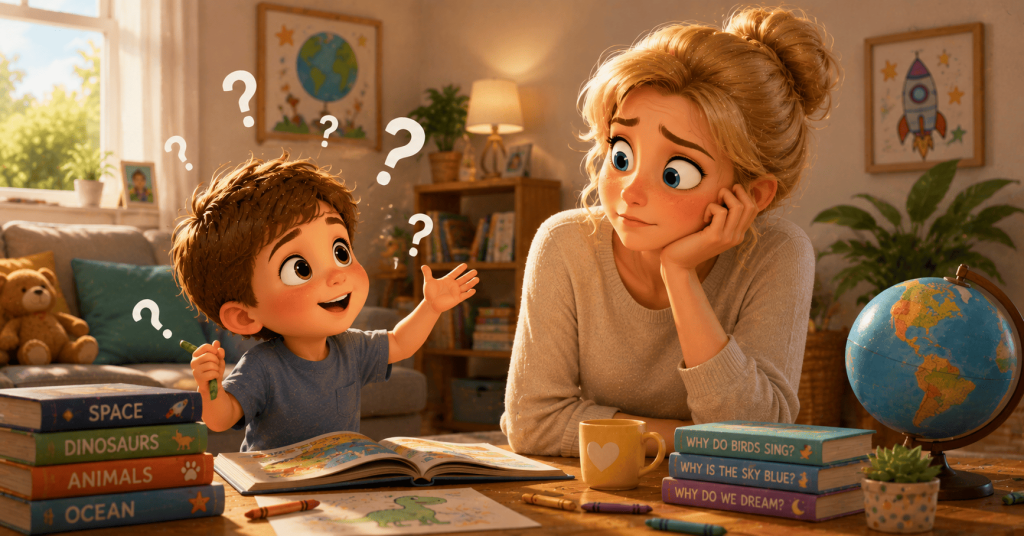
It starts before they are out of bed. Why do we have to wake up? Why is the sun yellow? Why can’t I wear pyjamas to school? Why does the dog not go to school? Why does the dog not have a school bag? Why can’t I have a dog school bag?
By the time you reach the car, you have answered roughly seventeen questions, deflected four, and completely lost track of two. And the school day has not even started.
If you have a child between the ages of 3 and 8, this is probably your life. And at some point — usually around question forty — you may have wondered whether it is normal, whether it will ever stop, and whether there is a polite way to put a pause on it.
Here is what no one tells you at the school gate: the relentless questioning is not a problem. It is a sign. And understanding what it signals changes everything about how you respond to it.
What the Questions Are Actually Telling You
Young children ask an average of 73 questions a day, according to research from the University of Michigan. Four-year-olds, the most question-intensive age group, ask one roughly every two minutes during waking hours. Most of these questions are genuine — they are not looking for attention, they are not testing boundaries, and they are not trying to slow you down. They are trying to understand the world.
This is curiosity in its purest form. And curiosity is not just a pleasant personality trait — it is one of the most important cognitive tools a child has. A curious child is, neurologically speaking, a child whose brain is actively building connections. Every question is a small act of learning.
Researchers at UC Davis found that when people are in a curious state, their brains show increased activity in the hippocampus — the area associated with memory formation. Curious children do not just absorb more information; they retain it better, connect it to existing knowledge more readily, and find it easier to recall later. Curiosity, in short, makes the brain work better.
Why Curiosity Matters More Than We Think
Most parents focus on knowledge — what their child knows, what they can recite, how well they do on tests. But researchers who study long-term learning outcomes keep arriving at the same finding: how curious a child is matters more than how much they already know.
A large study published in the journal Pediatrics followed children from birth through primary school and found that curiosity — measured as a drive to explore and seek new information — was as strong a predictor of academic achievement as IQ. Not a small effect. As strong as IQ.
This makes intuitive sense. A curious child walks into a classroom wanting to learn. They do not need to be pushed. They sit forward. They ask questions. They make connections between things. The teacher’s job becomes easier because the child is already engaged.
Compare that to a child who has learned, somewhere along the way, that questions are not welcomed, that wrong answers are embarrassing, and that the safest thing to do is stay quiet. That child may have perfectly good intelligence. But without curiosity to drive it, the engine does not turn over.
How Curiosity Gets Switched Off
Children are born curious. You do not need to teach a toddler to wonder — they arrive doing it. The more interesting question is: why do some children seem to lose that curiosity as they get older?
The honest answer is that curiosity is fragile. It gets worn down by the wrong kind of responses, often from adults who mean no harm at all.
The dismissive answer
‘Because that’s just how it is.’ ‘I don’t know, stop asking.’ ‘That’s not important right now.’ Children are good at reading tone. When a question is met with dismissal — even gently — the child learns that their wondering is inconvenient. Over time, they wonder less out loud, and then less overall.
The fear of wrong answers
Once formal schooling begins, children quickly learn that some answers are right and some are wrong, and that wrong answers carry social cost. A child who has been laughed at for a wrong answer, or corrected sharply, or who has watched another child be embarrassed, starts to play it safe. They only speak when they are certain. And certainty, by definition, requires no curiosity.
Too much passive entertainment
A screen that serves up constant content — videos, games, shows — gives a child’s brain what it wants (novelty and stimulation) without asking anything back. The brain stops generating its own questions because the questions keep getting answered before they are even formed. Passive consumption is not the same as active curiosity, and a steady diet of the former quietly crowds out the latter.
Being given the answer instead of space to find it
When a child asks a question and an adult immediately delivers the answer, the child gets the fact but misses the experience of wondering. The wondering is not just a means to the answer — it is valuable in itself. Children who are consistently handed answers without being given the chance to guess, explore, or work something out slowly lose the habit of doing so.
Create a Story They'll Remember Forever
Give your child a personalized storybook that inspires creativity, confidence, and a lifelong love of reading.
Create My Child’s StoryHow to Keep Curiosity Alive at Home
The good news is that keeping curiosity alive is not complicated. It does not require a structured curriculum, expensive toys, or dedicated learning time. It mostly requires small shifts in how you respond to the child who is already in front of you.
Say ‘I don’t know — let’s find out’ more often
This is the single most powerful thing a parent can do, and the most underused. When a child asks why the sky is blue and you do not know the answer, saying so — and then finding out together — does something remarkable. It shows the child that not knowing is fine, that curiosity leads somewhere, and that adults are still learning too. That combination is enormously encouraging.
You do not have to look it up every time. Sometimes ‘I don’t know — what do you think?’ is even better. It returns the wondering to the child and asks them to develop a theory. Thinking of possible answers, even wrong ones, is how understanding forms.
Ask more questions than you answer
It sounds counterintuitive, but one of the best ways to encourage a child’s curiosity is to be curious alongside them. When they make an observation, respond with a question rather than a fact. ‘Why do you think that is?’ / ‘What do you notice about it?’ / ‘What would happen if it were different?’
Children who are questioned thoughtfully learn to question thoughtfully. Over time, they stop needing someone else to ask — they start generating questions on their own. This is the goal: not a child who asks questions because they need answers, but a child who asks questions because wondering feels natural.
Let them be bored sometimes
Boredom is underrated. A child with nothing to do and no screen to fill the gap starts to look around, fidget, invent things, ask questions. The slightly restless child who announces they are bored is a child whose curiosity is looking for something to attach to. The answer is not always entertainment. Sometimes the answer is: ‘What can you find out about the ants on that wall?’
Take ordinary things seriously
A child who asks why onions make you cry, or why the moon looks bigger near the horizon, or why dogs sniff everything they pass — that child is doing science. Take the question seriously. Not with a lecture, just with genuine interest. ‘That is a really interesting question. What do you think is happening?’
When a child’s question is treated as worth thinking about, they learn that their curiosity has value. That feeling — of being taken seriously as a thinker — is one of the most motivating things a child can experience.
Read books that ask more questions than they answer
Not all books are equal for curiosity. Books that show a character exploring, wondering, and figuring things out — rather than being told — invite children to wonder alongside them. Non-fiction books about nature, science, history, and people are particularly good for this. So are stories where something unexplained happens and the reader has to make sense of it.
After reading, try leaving something unresolved: ‘I wonder why he made that choice.’ ‘I am not sure I understand what happened at the end.’ Let the child sit with the uncertainty. Uncertainty is where curiosity lives.
Practical Ways to Respond When You Are on Question 47
None of this means you have to answer every single question with full attention and a pedagogical framework. That is not realistic, and children do not need it. What they need is for their questions to be generally welcomed, not generally shut down.
A few responses that work well:
| Responses That Keep Curiosity Going “What do you think?” Returns the wondering to the child. Encourages them to form a theory before getting the answer. “That’s a good one. I’m not sure — let’s look it up later.” Validates the question without requiring an immediate answer. And actually follow through. “I’ve wondered that too.” Shows curiosity is something adults have as well. Normalises not knowing. “Tell me more about what made you think of that.” Slows the question down and explores the thinking behind it. “Let’s try something and see what happens.” Turns a question into an experiment. Works especially well with science-type questions. |
What to Avoid
A few common responses that, over time, quietly teach children to stop asking:
- ‘Because I said so.’ It closes the door. Children understand that rules exist for reasons. Even a simplified reason keeps curiosity alive more than a non-answer.
- ‘You ask too many questions.’ Even said lightly, this lands. Children hear it as: my wondering is a problem. Say it often enough and they believe it.
- Interrupting a question to finish it for them, or redirecting before they have finished asking. Let the question land completely before you respond.
- Answering in a way that signals the conversation is over — terse, distracted, while looking at your phone. Children read the signal, not just the words.
The Question Behind the Questions
When your child asks why the sky is blue, they are not really asking about light refraction. They are asking: is the world worth wondering about? Is wondering something I am allowed to do? Is there someone here who will take my thinking seriously?
The answer to all three is yes. And every time you respond to a question with genuine interest — even briefly, even imperfectly — you reinforce that yes.
The child who asks 73 questions before lunch is not exhausting you on purpose. They are building something. Your job is not to have all the answers. It is just to stay curious alongside them.
Create a Story They'll Remember Forever
Give your child a personalized storybook that inspires creativity, confidence, and a lifelong love of reading.
Create My Child’s Story