Kid Glued to the Screen? How to Reduce Screen Time Without Tantrums
Screen-free alternatives that kids actually love — and a bedtime reading routine that sticks
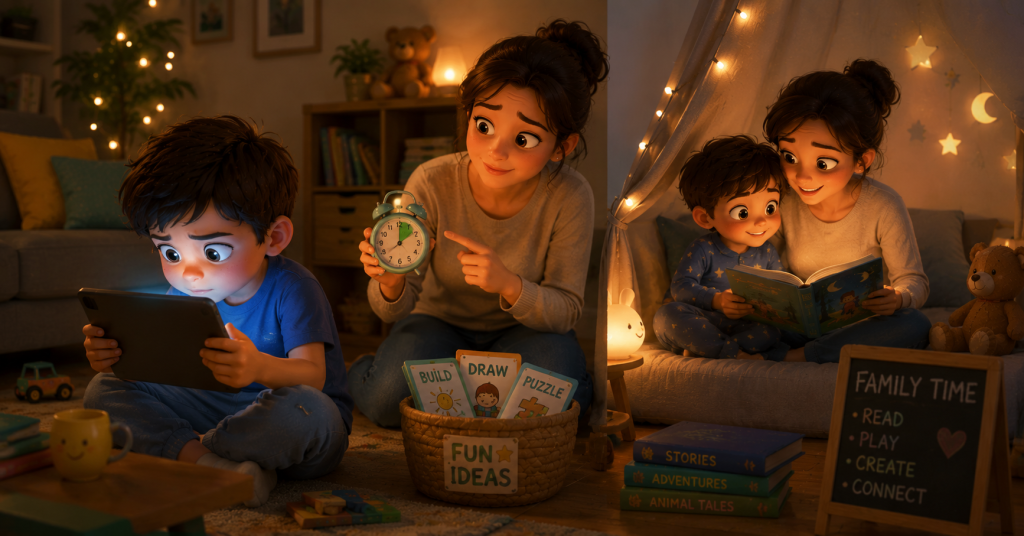
📌 Key Takeaways
What you’ll learn from this article:
- Banning screens does not work. Replacing them with something genuinely engaging does — and the replacement has to feel like an upgrade, not a punishment.
- Children are drawn to screens for specific reasons: novelty, stimulation, instant reward, and social connection. The best screen-free activities offer the same things.
- Screen time rules work better when they are predictable, consistent, and built into a routine — rather than decided in the moment when everyone is already frustrated.
- The bedtime routine is the highest-leverage moment for reducing screen time. A calm, consistent wind-down that ends with a story replaces the screen without a fight.
- Small, gradual changes hold better than sudden bans. Reducing screen time by 15 minutes a day is more sustainable than going cold turkey.
- Children who have rich offline lives — outdoor play, creative activities, books, real conversations — are naturally less pulled toward screens. The goal is not less screen; it is more everything else.
The Moment Every Parent Knows
It is Sunday afternoon. Your child has been on the tablet for two hours. You say ‘five more minutes’ at the forty-five-minute mark, again at the hour mark, and again just now. The five minutes are up. You say it is time to stop.
What follows is a negotiation, then a protest, then something that could generously be called a meltdown. The tablet gets taken away. The atmosphere in the house turns grey. Everyone is miserable. And somewhere in the back of your mind, a small voice says: it would have been easier to just leave them on it.
If that sounds familiar, you are in the company of virtually every parent in India right now. According to a 2023 survey by LocalCircles, over 70% of Indian parents reported that their child’s screen time had increased significantly since the pandemic — and most said they did not feel in control of it.
The good news is that reducing screen time does not have to mean daily battles. But it does require a shift in approach — from trying to restrict something to trying to replace it with something better.
Why Simply Banning Screens Does Not Work
The instinct to take the phone away and say ‘no more screen time’ is understandable. But it almost always fails, and for a predictable reason: it removes something the child is getting real value from without offering anything in its place.
Children are not drawn to screens because they are lazy or because screens are purely bad. They are drawn to them because screens are extraordinarily good at delivering what developing brains crave: novelty, stimulation, immediate reward, social connection, and the feeling of being in control of something. These are all legitimate needs. Taking away the delivery mechanism without addressing the need leaves a child frustrated, bored, and fixated on getting back to the screen.
The approach that actually works is not subtraction — it is replacement. Give the brain something else that meets the same needs, and the pull of the screen weakens naturally over time. This takes longer than a ban. It is also permanent.
What Screens Are Actually Giving Your Child
Before replacing screen time, it helps to know what specifically you are replacing. Different children use screens for different reasons — and the best alternative depends on what the child is actually seeking.
| What Children Get From Screens — And What Can Replace It Novelty and stimulation: Screens deliver constant new input. Replace with: nature walks, building projects, cooking together, visits to new places — anything that involves fresh sensory experience. Instant reward and progress: Games give constant feedback — levels, points, unlocking things. Replace with: puzzles, craft projects, simple board games, anything with visible progress. Social connection: Online games and video calls give a sense of being with others. Replace with: playdates, joint activities, family games, sibling projects. Control and autonomy: On a screen, children choose what to watch and play. Replace with: giving them real choices elsewhere — what to cook, what game to play, where to walk. Relaxation and decompression: After school, many children use screens to wind down. Replace with: outdoor play (physical movement is actually more effective for decompression), a snack and quiet time, or 15 minutes of doing exactly nothing. |
Screen-Free Activities That Children Actually Want to Do
The phrase ‘screen-free activities’ has a reputation for meaning craft kits that take an hour to set up, get used once, and leave glitter on the floor for a month. The activities below are different — low-prep, high-engagement, and genuinely compelling for most children.
For children aged 3–6
- Sensory bins: a container filled with rice, sand, chickpeas, or water with small objects hidden inside. Children will play with these for surprisingly long stretches. Almost no preparation.
- Building and constructing: wooden blocks, cardboard boxes from deliveries, empty containers — children this age build endlessly when given basic materials and left alone.
- Pretend play with real props: a bag with a few scarves, an old handbag, some kitchen containers. Children’s imaginations do the rest. Do not direct or structure it. Just provide the props.
- Outdoor time with a specific mission: ‘Find five things that are rough’ or ‘Count how many red things you see on the walk.’ Purposeful exploration holds attention longer than unstructured outdoor time.
- Listening to stories and audiobooks: an often-overlooked alternative. A well-narrated audiobook — available free on many platforms — gives the audio stimulation of a screen while building vocabulary and imagination.
For children aged 7–10
- Strategy board games: Ludo, Carrom, Chess, Snakes and Ladders — games with clear rules, visible progress, and social interaction. Keep them accessible, not stored away.
- Simple cooking and baking: children this age love genuine responsibility. A recipe they can mostly do themselves — a simple dosa batter, a fruit salad, scrambled eggs — produces engagement, pride, and a useful snack.
- Drawing comics or making a book: give a child a few blank pages stapled together and a prompt (‘make a story about a dog who can fly’) and many will disappear for an hour.
- Collecting and categorising: coins, leaves, rocks, stamps — the collecting instinct is strong at this age. Give it a container and some structure and it will occupy significant time.
- Pen pal letters: writing a letter to a cousin, a grandparent, or a friend in another city — to be sent physically by post — is genuinely exciting for children who have never sent or received a real letter.
Screen Time Rules That Actually Hold
The problem with most screen time rules is that they are made in the wrong moment — either in the heat of a battle, or as a general policy announced at dinner and forgotten by Tuesday. Rules that hold are built differently.
Set times, not amounts
‘One hour of screen time per day’ is a rule that requires constant negotiation about when the hour starts and stops. ‘Screens are for 5 PM to 6 PM’ is a time boundary that becomes predictable and therefore easier to accept. Children handle time-based rules much better than quantity-based ones because they know exactly what to expect.
Give ten minutes warning — every time
The transition off a screen is the hardest moment. It is easier when it is not a surprise. ‘Ten more minutes, then we’re done’ — said clearly, once, without negotiation — gives the brain time to prepare for the shift. Children who are cut off mid-game with no warning react much more strongly than children who were told a transition was coming.
Agree the rules together when everyone is calm
Rules imposed in the middle of a conflict are resented and resisted. Rules negotiated at a calm moment — ‘let’s talk about screen time this week, what do you think is fair?’ — have buy-in. The child who helped set the rule is more likely to follow it. The conversation also surfaces what the child actually values about screen time, which helps with replacement.
Be consistent more than you are strict
A rule that is enforced 90% of the time is more effective than a strict rule enforced 60% of the time. Inconsistency teaches children to push, because pushing sometimes works. Consistency — even at a more generous limit — teaches children that the boundary is real.
Create a Story They'll Remember Forever
Give your child a personalized storybook that inspires creativity, confidence, and a lifelong love of reading.
Create My Child’s StoryThe Bedtime Routine That Replaces Screens Permanently
The highest-stakes moment for screen time is bedtime. Screens before sleep are the habit that parents most want to break and find hardest to break — because after a long day, a screen is the path of least resistance for everyone.
But the bedtime routine is also the highest-leverage intervention. Get this right and you solve screen time and sleep and reading habit in one go.
Here is a routine that works — tested in households across India, sustainable on school nights, and adaptable to different ages:
| The Bedtime Routine — Step by Step 7:45 PM — Screens off. All screens, including TV. This is non-negotiable and the same every night. Consistency trains the brain to expect the transition. The first week is the hardest. After two weeks it stops being a fight. 8:00 PM — Bath and wind-down. Warm water lowers cortisol. This is not just hygiene — it is biology working in your favour. Keep it calm and quiet. 8:15 PM — A small snack if needed, then into bed. Hunger makes wind-down harder. A light snack — a banana, a small glass of milk — removes that variable. 8:20 PM — Your child picks the book. From a shelf of pre-selected options. Ownership of the choice increases engagement with the reading. Let them choose even if they pick the same book again. 8:20–8:35 PM — Read together. You read aloud, or they read to you, or you take turns. No comprehension tests. No lessons. Just the story and the warmth of being together. 8:35 PM — Lights out. The story was the last input. The brain goes to sleep with language, characters, and imagination — not with blue light and dopamine hits. |
Within two to three weeks of running this routine consistently, most children stop asking for a screen at bedtime. The story becomes the thing they expect and look forward to. The screen stops being missed because it has been genuinely replaced, not just removed.
Practical Notes for Busy and Working Parents
One of the most honest things to say about screen time is this: for working parents — particularly in cities, with long commutes and demanding jobs — screens are not laziness. They are childcare. They are the thing that keeps a child safe and occupied while dinner is being cooked or a call is being taken.
This is real, and it is not something to feel guilty about. The goal is not to eliminate screens from a working household. It is to manage them so they are a tool you choose rather than a habit that runs itself.
- Designate specific screen-free periods rather than trying to reduce overall time. Meals and bedtime are the two highest-leverage slots.
- If screens are needed for occupying children during busy hours, choose what goes on them. An audiobook or an age-appropriate podcast occupies a child without a screen while you cook.
- Prepare one or two ‘go-to’ activities in advance — a puzzle on the table, a colouring book open, a small sensory bin ready — so the screen is not the only option when you need hands-free time.
- Give yourself the same grace you would give a friend. No parent manages screen time perfectly. What matters is the general direction over months, not every single evening.
How Long Does It Take?
Parents who make consistent changes to screen time routines typically describe the same timeline: the first week is the hardest, the second week is easier, and by week three to four, the new routine has become the expected one.
The shift does not happen because you took something away. It happens because you built something else — a bedtime routine, a set of activities the child actually enjoys, a predictable structure the child’s brain can relax into. Once that is in place, screens matter less because life without them is full enough.
Start with one change. The bedtime screen — the last one before sleep — is usually the one worth tackling first. Replace it with a book, keep it consistent for two weeks, and see what happens. Most parents are surprised by how quickly the fight disappears once the alternative becomes familiar.
Create a Story They'll Remember Forever
Give your child a personalized storybook that inspires creativity, confidence, and a lifelong love of reading.
Create My Child’s Story